Showing posts with label honey. Show all posts

Friday, June 13, 2014

The Queen Has Arrived!

We spotted the queen within 3 minutes of opening the hive. It was a quick game of Where's Waldo! The queen is the bee with the black shiny thorax and wings folded over her abdomen.
 I am excited to say we have a queen! We spotted our lady within a few minutes of opening the hive on the third frame we looked at. She looks healthy and she had lots of attentive workers. I am not sure if she has mated yet as we did not see any brood. We looked for new eggs and only found pollen and nectar. The hive was very clean and I think they are ready for her to start laying. Once we get some full frames of brood, we are still going to do a hive split.

We entered the hive on Wednesday, June 11, 2014 at 11:15 am. The weather was about 70 degrees and sunny.

We will inspect the hive for eggs on Saturday (weather permitting) and every 3 days or so until we find it. They we will mark and clip the queen so we can easily find her in future inspections.

This one cell full of bright orange pollen was such a beautiful sight.

There were still lots of bees in the hive despite having a look with all of the foragers out.

The comb is clean with no brood at all, but there are cells of pollen and nectar scattered throughout.

Tuesday, May 13, 2014

We Saw The Queen!

Her Majesty, Queen of Autumn's Apiary, was spotted today during our hive inspection. We were thrilled to see her and all of the work she has been doing, laying full frames of brood!

We spotted our queen today!
Just in case you couldn't see the giant bee...that is the queen!

 We installed a little bracket on our fence beside the hive to help us hold the top bars full of comb and bees. My partner helped with keeping track of the order of the bars and inspecting for brood.

One of the sections of  comb was fully capped brood! There was more larvae on the other sections as well, but these will all be bees soon!!

One bar of comb with capped brood!

Closeup of the capped brood with cells of honey.

The comb is getting larger and with the new additions coming soon, this hive will easily double in size within the next month. 
The hive is growing!

Awwwe.... aren't they just the cutest!

I saw quite a few drones this time. Can you see the difference in size? This drone hung out with me during the hive inspection. Bees continually amaze and inspire me.

The big bee with the large eyes is a drone! I was hoping to photograph one so those following my BEE FACTS can see the difference.

 Bee Observations:
 We wanted to make sure there was brood and if possible to see the queen. We also wanted to assess if we should put the next super on top of the hive.

It was 62 degrees and sunny when we entered the hive at 9:45 am. The bees were active and very busy tending to the hive and bringing in pollen. They did not seem to mind our inspection today. We took off the outer most empty bars to get to the comb. We carefully pulled out each bar, making sure to keep it level and transferred it to the holding area. We noticed one full frame of capped brood, and 4 other frames with larvae! They were all surrounded by uncapped honey, ready to feed the babies. The comb had grown another 2-3 inches on all sides and the bees expanded to the next bar. There were about 100 or so dead bees in the bottom of the hive. We are keeping the entrance small (reduced) until the hive gets a little bigger and can defend a bigger entrance. I did not see any evidence of disease or pests. These bees are healthy and were not aggravated by our entrance. As we were reassembling the hive, my partner spotted the queen. She was near some uncapped brood being followed by her entourage. She looked good and is doing a great job!

Little bee larvae!

Wednesday, May 7, 2014

Hive Peek

Today I had to go into the hive and retrieve the bee box all of the bees came in. So while I was in there I took a peek at how things were progressing. It has been 6 days since they have been in the hive and they are building up quite the comb!

Under that cluster of bees is where they have built their comb. Amazing how it is in a hexagonal shape.

Close up of the bees before I started pulling out the bars of comb.

Here you can just see the pure white comb under all of those bees. The top half of the photo has cells with honey in them :)

This was third from the center and not the largest piece of comb. They are doing very well.

Here is a look inside the hive without three of the top bars (which were on the bar holder). Amazing how bees will build naturally when they are not in a structured frame.

I got the bee box out and let the stragglers that were still inside find their way to the hive.
OBSERVATIONS:
Today was sunny and 60 degrees at 10:30am when I entered the hive. I did not use any smoke and did not move them any more than I had to to get the bee box out of the hive.
They had built their comb on the top bars we set in the hive. Since we don't have frames they are not restricted on the size or shape of comb they can build. The largest piece of comb was over 6 inches deep and 8 inches wide. The comb was pure white in color. The parts of the comb closest to the bar was full of honey. I did not notice any brood, yet. There were about 100 dead bees in the bottom of the hive. I assume they were from the transport and establishment. Otherwise the bees look healthy and are very active and not aggressive.

Tuesday, June 11, 2013

Hive Inspection June 11...

I went into the hive today after I discovered a few bees dying outside the hive with deformed wings. I am pretty sure my bees have mites. I decided to try and treat them with peppermint oil. I added 5 drops to one pint of syrup in an entrance feeder. I got pretty worried about not seeing any foragers coming and going, but it has been chilly (below 50 and just started raining) so that is probably the reason they were not out.
Hive inspection...

I did a thurough examination of the frames with the bees on them. The first frame of honey that I was worried about was actually capped honey. I stuck the end of a stick in it and was excited to see the liquid gold!
The bees are chaining or measuring the distance of the frames.

I found my queen as well and she was looking great! She was on the frame with the most bees and brood.
The queen! I found my queen!

I am still pretty worried about the hive, cause I saw about 3 bees with deformed wings. I am going to do some research on the mites and alternative, organic treatments and see what I can do.

Hive mid inspection.

Saturday, June 8, 2013

Hive Inspection 6/7/13....

Andrew and I going into our hive.
I wanted to do a hive inspection at 2 weeks from the last time. I am very curious about what is going on in there, but I don't want to bother the bees too much. So we got all of our gear on in 85 degree, full sun weather and inspected the hive around 2pm.

Hive inspection June 7, 2013.


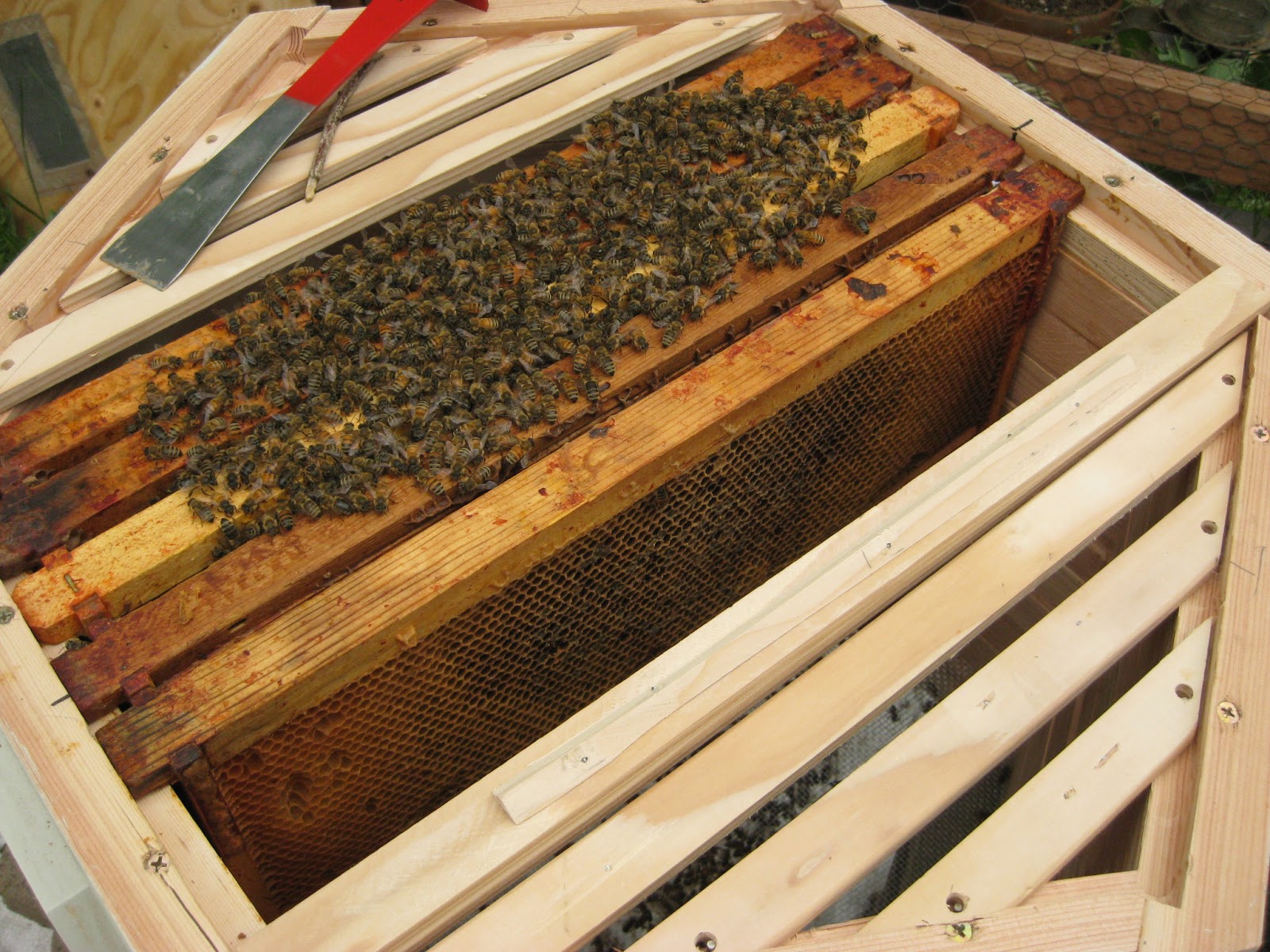
I have been noticing more and more dead bees in the bottom board of the box. I would say it is about 200 or so. The undertakers have a lot of work on their hands and have been flying the dead bees out as much as they can. I believe my hive is smaller than what it was when I got them and they have not started building any new comb. 

Frame full of uncapped honey/nectar with lots of bees.

 We went frame by frame and I took some photos while Andrew lifted each one out. We saw a frame full of uncapped honey or possibly nectar and several frames of brood. Most of the brood is uncapped with little curled up grubs in it. I was not able to find the queen but from the laying pattern, I am confident she is in there.

Some bees and brood but lots of empty cells.

I have some a few concerns about the look of some of the brood and comb. I did notice A LOT of empty cells throughout the hive and no new comb being built on any of the top bars. On the first frame we pulled out there were only a few bees on it and the cells looked a bit strange to me. I am not sure what is going on and I feel like it will be necessary for me to go back into the hive tomorrow, to thoroughly look at this.

These are the cells I am questioning.

I did notice quite a few newly hatched bees, and a ton of grubs. I am hoping this hive just needs time to repopulate and grow stronger.


Bees caring for the grubs.

Some of my observations:
-Did not see the queen
-Lots of empty cells
-Questionable cells
-Many new bees
-No new comb
-No capped honey
-Quite a few dead bees on the bottom board and surrounding the hive
-Lots of grubs

Sunday, May 5, 2013

Good plants to have for bees...

I am going to be doing a bit of research on the diet of bees. I know they like nectar and help pollinate, but I want to try and figure out exactly what they like to eat, and what is the healthiest for them. Currently I have a GIANT vegetable garden that has recently been planted. Nothing is flowering out of that yet, but other plants in my yard have already started flowering.

I have the following plants, trees bushes in my yard:
2 cherry trees (Ranier and Black)
4 apple trees (Jonathan, Golden Delicious and some kind of red)
2 fig trees (Green and Black)
Oregano
Marjoram
Parsley
Borage
Chives
Lovage
Hissop
Lemon Balm
Comfrey *
Lavender *
Rosemary *
Strawberries
24 rose bushes
Centaurea Montana
Full butterfly garden bushes
Tulips
Irises
Lilac Bush
Dandy Lions
White Little Daisy Plant?
Grass
In my vegetable garden I will have peas, beans, cucumbers, tomatoes, artichokes, asparagus, lettuce, spinach, potatoes, carrots, basil, squash, zucchini, sunflowers and more...

Here they mention bees like Borage http://www.rosybee.com/?p=165

Herb plants for bees http://www.buzzaboutbees.net/herb-planting-for-bees.html
"Lemon Balm In the past, beekeepers would rub a handful of lemon balm (Melissa officinalis) inside the hive after hiving a new swarm, in order to help the swarm settle and to encourage them not to leave the hive. Rubbing hands with the leaves is also claimed to help prevent bee stings!"

"Buying Flower Bulbs For Bees
These days, pesticides may be used in the cultivation of bulbs and plants by the horticulture industry. Neonicotinoids are systemic pesticides, and are a subject of much controversy – read more about this on the page honey bee deaths and pesticides. These pesticides persist in soil, and are not easily degraded.

In order to make doubly sure I avoid any possibility or risk that I will unwittingly poison the bees or pollute my garden soil with any pesticide contaminating my flower bulbs, (or indeed other plants), I take the following precautions:

I either -

    1. Buy organic, or
    2. Swap with friends and relatives with similar views, or
    3. Buy them from a local farmers' market, where we are fortunate to have a plant stall owned by a hobby gardener I trust, or
    4. Purchase from a local nursery I trust."


 * Excellent for Bees!


I just planted a Rosemary plant this morning. It looks like I need to boost my lavender and rosemary garden...

Building a bee box...

Here is a list of a few websites I found that have plans for building your own bee boxes.

Langstroth Bee Boxes:
http://www.beesource.com/build-it-yourself/

http://www.michiganbees.org/wp-content/uploads/2012/01/Hive-Bodies_20110323.pdf

http://www.americasbeekeeper.com/Beehive_Building.htm

http://extension.illinois.edu/~vista/html_pubs/BEEKEEP/CHAPT2/2-16.gif

http://www.ag.ndsu.edu/aben-plans/6324.pdf

http://www.colonialbeekeepers.com/index.php?option=com_weblinks&view=category&id=28&Itemid=57

HEX Hives:
http://warre.biobees.com/hexagon.htm

http://warre.biobees.com/hexagonal_hive_plans.pdf

http://www.petalumabees.net/hexhive.htm

Calculator for dimentions http://warre.biobees.com/calc/


TOP BAR Hives:
http://talkingstick.me/bees/tanzanian-tbh/